
SECURE AI NETWORKING
(A Living Cybyr.com document - first published September 22nd, 2026)
Ransomware Prevention in the AI Age
Since writing the page/article on the evolution in AI in mid-2026, (AI journey), it seemed important to ascertain whether strategies on security and networking were still viable as AI evolved.
For instance, does the uncertain identity of AI agents or new AI-based cyberthreats such as Shadow AI and Prompt Injection invalidate the detection and removal of ransomware previously used. What should be strengthened as new threats are constantly evolving and adapting?
“Did these changes break Zero Trust Secure Networking?” or the methodology in my “Assume Breach” article, written, just 18 months earlier. The world has changed so much since then. I had to see if these changes invalidated the interception of ransomware and disruptive attacks.
However, the development of investigative AI implementations is a breakthrough in removing vulnerabilities. Who will be the winner? Will humans develop strategies with AI or will threat actors work to subvert defensive intentions by manipulating AI, and end the world (as one Ex-AI developer thinks)?
Overall, the good news is that “the why”: minimizing ransomware and other attacks, is now enhanced by adding a novel safety net of human approval for high-risk transactions and more.
Background of this lengthy page.
This page began its life in the Spring 2025 edition of ISE magazine under the title “Assume Breach – Now What?” and evolved on the site on cybyr.com/breaking. Then, AI was integrated with Ransomware. A new article published in the Fall ISE Magazine looks at the impact. That article is developed further on this page which will remain under development as the topic evolves.
Our 2026 Definition of Ransomware Attacks.
A sophisticated combination of malicious software or Agentic AI elements that disrupt organizational, user, company and client data and with systems encrypted, locked or destroyed until a ransom is paid.
The threat: Loss or exposure of private data, disruption or cessation of business-critical operations.
Detecting Disruptive Attacks that are not Ransomware-focused
Many attacks on Critical Infrastructure Sectors such as utilities, government etc., can use similar characteristics and this methodology is also likely applicable to remove those distructive threats.
This Page Describes the Following Secure AI Network Framework
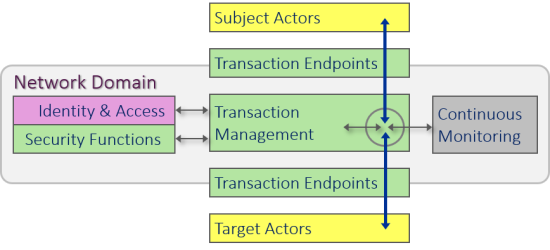
Let's Start with the Reasons that this form of Cyberattack is the Most Important
It’s important to realize that we are at war! Nation states now rely on the income extracted and also fund malicious attacks that focus on disruption to critical infrastructure systems such as water supplies. It’s a growth industry, slated to reach $74bn in 2026 – 35% growth over 2025. Although the focus here is on Ransomware, much also applies to disruptive attacks. collectively described as Advanced Persistent Attacks, etc.
-
-
- AI assisted models adapt in real time to modify attacks.
- “I’m too small to be attacked” doesn’t cut it any more.
- Thousands of automated attacks target anyone with cash. Google’s 9/26 Threat Report revealed that threat actors are deploying fully autonomous agentic workflows that act as core attacker infrastructure
- Technical skills required are minimal since many use a platform known as Ransomware as a Service.”
- Yes, there are expensive defenses but these are often temporary or are just fighting the wrong battle.
-
Why Ransomware is Best Attacked in a Network
Ransomware has characteristics that can be detected.
| 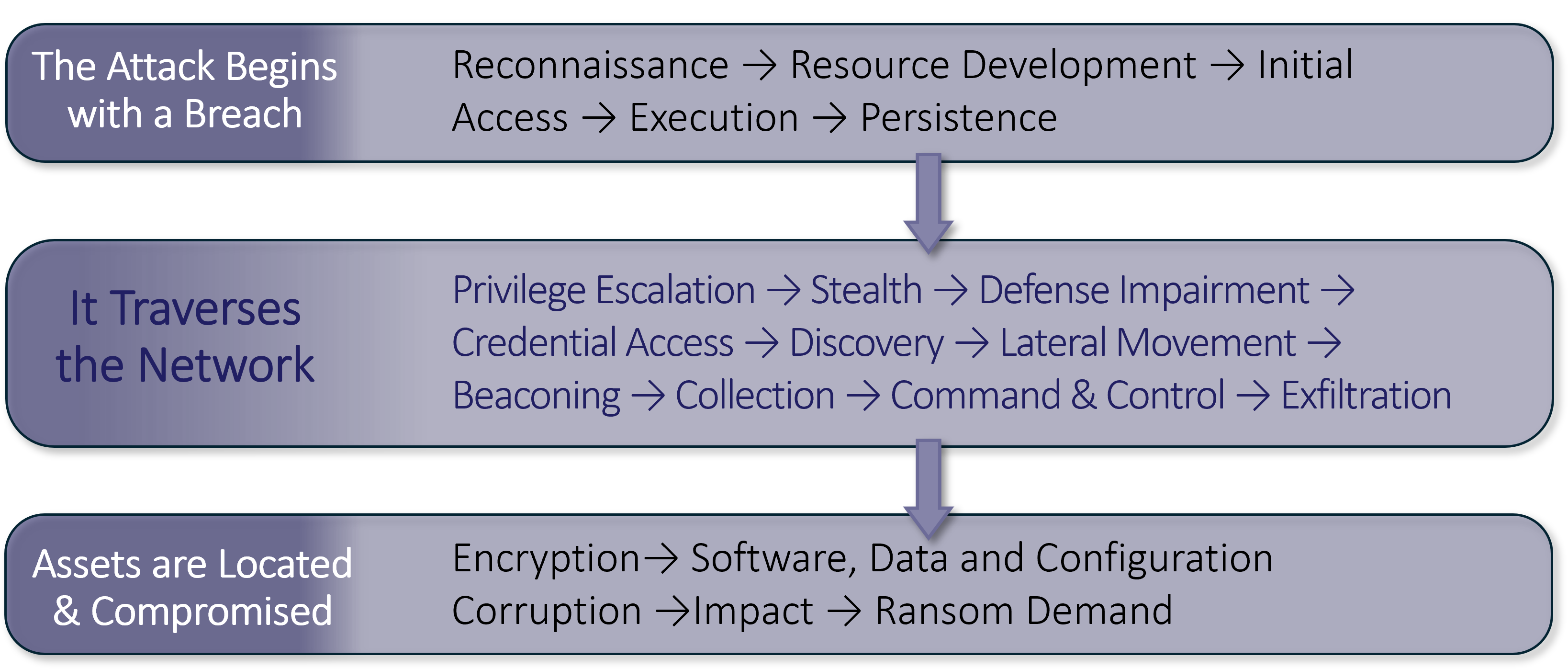 Based on MITRE ATT&CK® 15 Attack Categories. More on ransomware in the footnote of this page. |
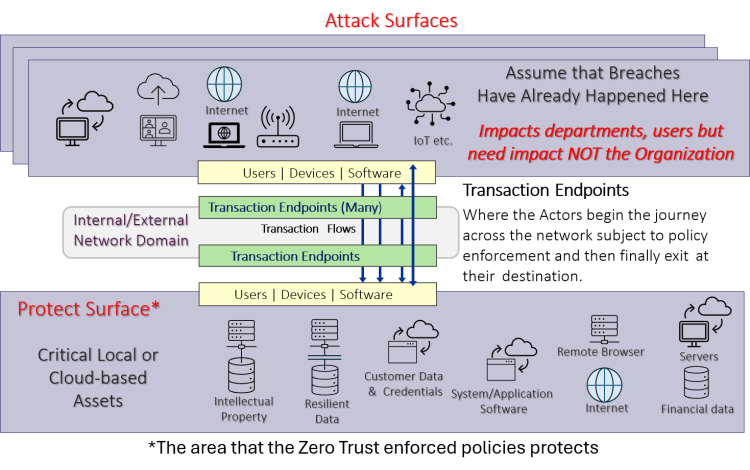
The Obvious Conclusion: Separate those systems that may be breached from the organization's key assets.
In Zero Trust terms, this means creating Protect Surfaces, ensuring that all critical assets are accessible only through verified and continuously monitored transaction paths, whether local or cloud-based.
The Secure AI Network Framework, Step-by-step
The key is examining all aspects of a transaction, beginning with an attempt to reach another system. Transaction Endpoint must get permission from the Transaction Manager to begin a transaction. Nothing and no-one is trusted.
Subject and Target Actors conducting transactions.
- Users communicating with a remote host, database or hosted application via user portal, agent software, data center or cloud application, etc.
- Software and applications of any kind, including the system software that controls this network system—easily the most common type of actor.
- An Agentic AI system, software or a device conducting automated functions. Increasingly, these are now proxies for user functions.
- Devices such as IoT devices, Medical Robots or critical infrastructure devices in OT networks. They could also be systems that act as a proxy for a non-intelligent devices.
Transaction Management: Authorization and Access Control..
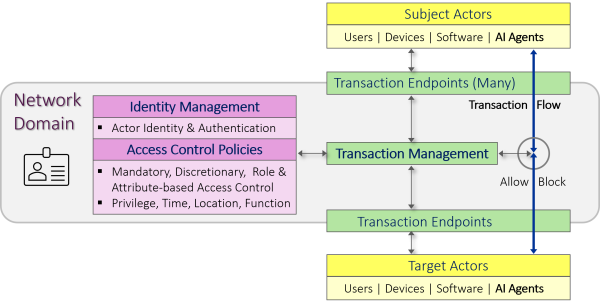
The Transaction Manager Enforces the Policies. Also known as the Policy Manager, it Authorizes, Allows/Blocks & Manages Transactions, Security Functions. Both Subject & Target Transaction Endpoints, also known as Policy Enforcement Points, must get permission from the Transaction Manager in order for a transaction to begin. Nothing and no-one are trusted:
- Verify that the requested transaction is permitted by the Identity Manager and Authentication Software
- This may vary dependent on the Subject Actor type. MFA, Passkey, etc., which have become the norm for user access, secure APIs. Other identity verification is required for software including proxy software front-ending legacy hardware devices, etc. Verifying AI agents with the ability to change their identity may require human intervention.
- More importantly are the associated access controls and policies and that the requested functions are within the approved Access Control policies for that actor, etc. See our cyberpedia site for full details of NIST access controls. Some key points are: permitted transactions including acceptable target actors, amount of data being transferred, time of transactions, location and IP address of subject actor, allowed privilege levels, etc.
- There may be special controls needed for identifying AI-based denial of service or other out-of-policy attacks.
- It then completes the pairing by checking whether the transaction is allowed by similar policy attributes of the Target Actor.
- When a transaction begins, the Transaction Manager adds it to the Monitoring Database.
Transaction Management: Security Functions
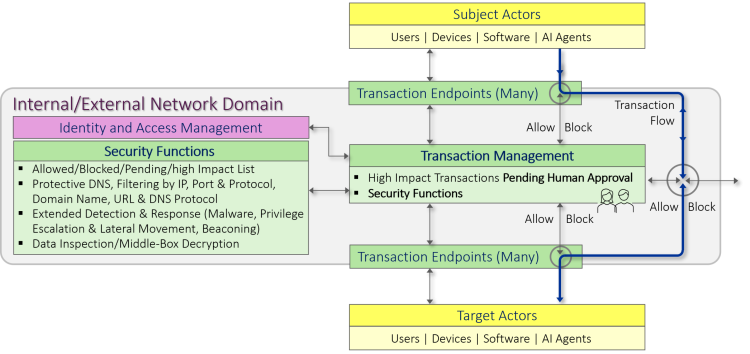
The Transaction Manager intercepts the transactions, applying the Security Functions indicated in the above figure, to detect and remove threats, including examining the payloads, detecting of out-of-policy or altered requests, and Extended Detection and Response Software to detect Ransomware attack characteristics. These include performing some or all of the following actions: IP, Port and Protocol Filtering, DNS Protocol Filtering, Domain Name Filtering, URL Filtering, Malware Detection and Removal, Data Loss Prevention, Protective DNS or decryption and re-encryption by a Middlebox Security Function. The capabilities required to support these Security Functions are also defined.
An important new safety net approach requires human approval to allow all high-risk transactions, i.e. those typified by Ransomware attacks, must be quarantined pending human approval.
Continuous Monitoring Functions
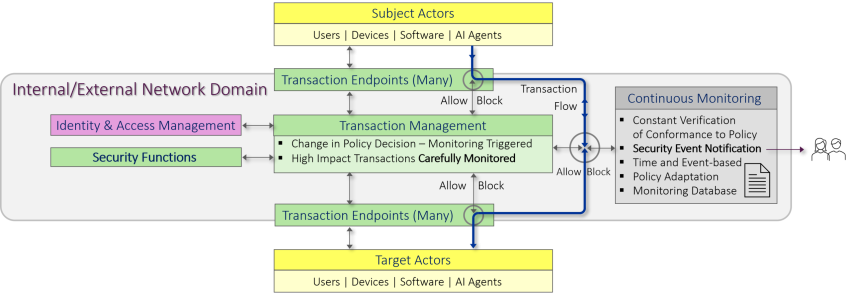
Monitoring notifies the Transaction Manager when changes occur such as changes in access control or approved functions that may result in the transaction being blocked or quarantined. This includes functions being initiated by AI agent software. Secure event notifications are initiated.
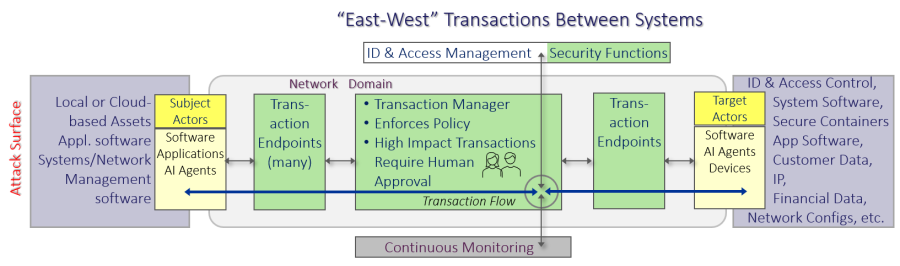
Example: Implementing N-S The diagram on the right is known as “North-South” with users or clients-side software transacting with databases, cloud applications or OT networks. Example: Implementing E-W Shown below is known as “East-West” datacenter/cloud to datacenter/cloud transactions. This represents about 80% of transactions. Many other configurations exist. | 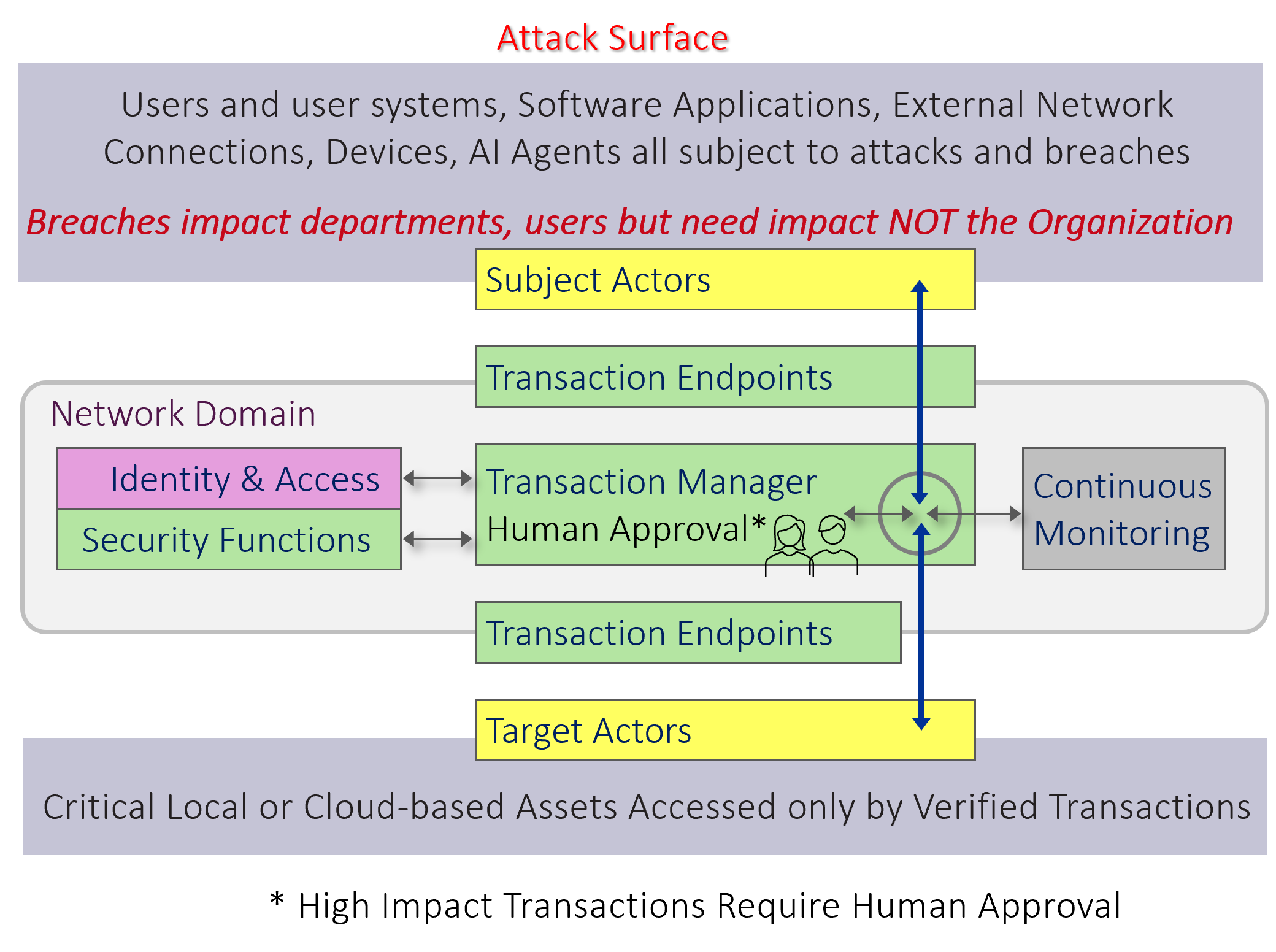 |
Concluding Actions and Closing Thoughts
AI Related Actions
Caution: To guard against Shadow AI attacks, in all case the software in such systems must be verified. If any elements of the systems are vibe coded then it is essential to understand what the code does, any open source packages that they use and in all cases their vulnerability must be tested with the latest AI models. This is obviously an ongoing process especially where automatic software updates must first be verified. In all cases a human safety net is a must to ensure integrity of the operation.
New Rules of Operation
Software supplied by third parties must also be verified and never trusted. This is a developing function as using AI to discover vulnerabilities and conduct real-time patching becomes the norm. It would be considered very high risk to use software created using AI vibe coding without checking the code AI agent created.
Proper self-attestation and demonstrable use of security best practices – DevSecOps, SBOM, etc. External NOC systems should not use AI Agents that can initiate transactions.
Nothing here removes the need for an AI implementation plan or the adherence to the organization’s Security Policy.
Lessons to be Implemented
- The Zero Trust principle: “Assume Breach” applied by service providers or enterprises with a strategic framework to intercept attacks is not just confirmed but is enhanced.
- The Zero Trust principle: “Never Trust, Continually Verify” becomes even more important.
- The use of AI to detect software vulnerabilities and the requirement for all software to conform to high standards and be automatically updated is taken to a new level.
- We do not assume that verifying an agent once is sufficient. Even if they adapt and transform and spawn new agents their identity must still be constantly monitored and verified.
- The approach is scalable and can grow organically to verify and enforce the transaction independently of the actor.
- Continuous monitoring after authorization to detect agentic or out of policy shifts is essential.
- Escalation of high-impact actions to now require human approval is an important safety net.
- The approach does not attempt to provide a perfect solution but greatly strengthens an organization’s resilience especially when applied with enhanced defensive strategies.
AI Related Actions
This page, like so many others, is informative, providing guidance on what can be done to reduce the risk of attack. I.e., it tells you what to do but does not tell you how to implement the concepts since such implementation is organization-dependent and must fit in with existing systems, expertise and budget.
There are several implementation possibilities:
- Our Virtual CSO Service exists to address implementation. Being independent, this page also does not make recommendations on who to use or even list possible software solutions for (say) Network Detection or Extended Detection and Response(XDR) software, etc.
- You can create your own implementations, using AI or automating existing tasks with AI.
- You can use a Tier 1 service provider, MSSP or systems integrator for all or some of the functions here.
Footnote
The Nature of Ransomware and How It Works
- Attacks and breaches can occur anywhere across the Information Ecosystems: in subscriber systems, in multiple clouds and remote user systems.
- Increasingly, hybrid cloud environments mean that transactions span this ecosystem where the protect surface and attack surface are distributed.
- With 80+ threat types focused on penetration of defenses and the reliance on the correct execution of 40+ defensive actions it is inevitable that mitigating actions are missed and that breaches occur.
- Ransomware continues to evolve and become more sophisticated making a fix-and-forget strategy untenable.
Modern ransomware operations increasingly use many of the same techniques associated with Advanced Persistent Threats (APTs): establishing persistence, discovering valuable assets, escalating privileges, moving laterally, evading defenses and exfiltrating data before disruption or encryption.
As opposed to malware, which typically acts immediately, an APT is a sophisticated, often complex and sustained cyberattack that is today’s principal vehicle for ransomware. An APT attack consists of techniques for initial penetration to create a breach, infiltration and discovery of vulnerabilities and corrupting or exfiltrating information as described in detail below. It’s the APT that enables the Ransomware attack’s potency.
- Having penetrated a system, the Threat Actor establishes an undetected presence that compromises the system and establishes a hard-to-detect foothold by hiding Malware inside legitimate systems, applications and data files.
- They can also leverage file-less infiltration by corrupting native tools such as PowerShell or Windows Management Instrumentation, etc. These are known as “Living-off-the-Land” and such exploits are typically hide in end-user systems until activated and are therefore not detectable by end-user security software. In 2025, this technique is being bypassed by malware imbedded in seemingly innocent applications.
- Note: MITRE|ATT&CK lists 14 attack categories that are relevant.
Indicators of Attack in the Network
Having created a breach the following steps happen that have the potential to be detected:
- The act of Discovery (MITRE TA0007)[1] is the technique used by threat Actors to explore systems for vulnerabilities. There are 25 techniques listed by which an adversary may explore a system. Where that spans the SASE service, these can be detected by applying the Zero Trust methodologies below.
- It may prepare for an attack by elevating its privilege level and seeking targets in the systems’ network. Then it may lie dormant, Beaconing its remote host and lying undetected in systems for a long time. This is the first sign detectable in a Zero Trust enabled network.
- When activated, it will invoke one of more Lateral Movement attacks to infiltrate connected systems, operating out of infiltrated applications. This is also detectable in a SASE Service of Zero Trust enabled networks.
- To complete the attack, the next phase begins data exfiltration, damage or encryption to systems and applications etc. The result can be anything from disruption, identity or data theft, system and application software encryption, ransomware, etc. Attempts at bulk exfiltration are also detectable. Likewise, attempts at illicit encryption or corruption of software systems, device firmware and software.
While there are never guarantees in cybersecurity, it’s those signature techniques which, if curtailed, can prevent ransomware or severely reduce its success. Welcome to the journey.