
PROTECTING THE PROTECTION
(This is a preview of a living Cybyr.com document)
This page has links from the printed article distibuted on November 16th 2026.
It will be part of the navigation from December 1st
Preventing Organizational Disruption and Ransomware in the age of AI
My final article of 2026 covered the innovations required to protect organizations from disruption with a new chapter in the evolution of Zero Trust networking for the AI age.
For instance, does the uncertain identity of AI agents or new AI-based cyberthreats such as Shadow AI and Prompt Injection invalidate the detection and removal of ransomware previously used. What should be strengthened as new threats are constantly evolving and adapting?
This page introduces the ideas that places Secure Zero Trust Networking in a new light. It shows how AI does not break Zero Trust Secure Networking. Instead, it greatly enhances it.
Most importantly, we answer the seemingly unanswerable and recursive question:
What protects the protection .. and what protects that protection …?
The outcome connects directly to executive driven resilience, business enhancement and holistic cybersecurity policies.
Background of this page.
This page began its life in the Spring 2025 edition of ISE magazine under the title “Assume Breach – Now What?” and evolved on the site on cybyr.com/breaking. Then, AI was integrated with Ransomware. The ideas continue to develop as the threats and associated with AI continue to introduce new exploits.
Starting with the Basics
Historically, organizations have been exposed to disruption and operation-ending attacks because systems have been breached with unfettered access to key information, devices, network and critical infrastructure devices. Initially, these ransomware and disruptive attacks have grown increasingly sophisticated. The advent of almost instant discovery and exploit of vulnerabilities enabled by Agentic AI.
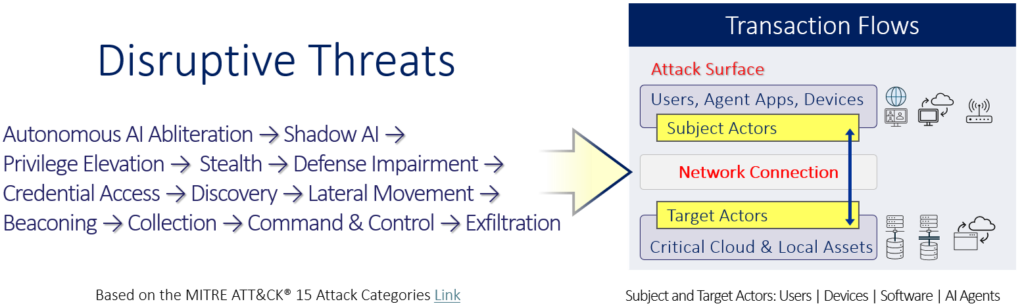
Our 2026 Definition of Ransomware Attacks.
A sophisticated combination of malicious software or Agentic AI elements that disrupt organizational, user, company and client data and with systems encrypted, locked or destroyed until a ransom is paid.
The threat: loss or exposure of private data, disruption or cessation of business-critical operations.
… and Disruptive Attacks
Many attacks on Critical Infrastructure sectors such as utilities, government etc., use similar characteristics.
Enter Zero Trust: How It Prevents Disruptive Attacks
Elements of a Zero Trust Network Implementation
- Access to critical assets is only via many Transaction End Points placed at the access to the network. (a.k.a. Policy Enforcement Points or PEPs).
- Each PEP connects to the Transaction Manager (a.k.a. Policy Decision Points or PDPs to authorize transactions)
- The Transaction Manager has 4 tasks to decide whether to authorize a transaction
- Approve the identity and authentication of the transaction initiator.
- Verify that the subject actor is permitted to conducts the transaction. Importantly, this also validates the Access Policy of the target actor.
- Once authorized, it initiates monitoring the transactions.
- It also applies security functions to detect if the transaction includes the type of attacks shown above. In either case, an innovation is the safety net of high-impact transactions such as access or disruptive actions on critical actions requiring special approval from an external source.
- Once enabled the transaction can proceed to the Organization’s Protect Surface described on the right.
Breaches Are Assumed – One of the two principles of Zero Trust.
In the world of AI and cyber threats having the organization, its users, contractors and supply chains 100% guaranteed protected is impossible.
The key is to avoid organizational disruption and making it holistically stronger so that its purpose can be fulfilled for its community of clients and customers.
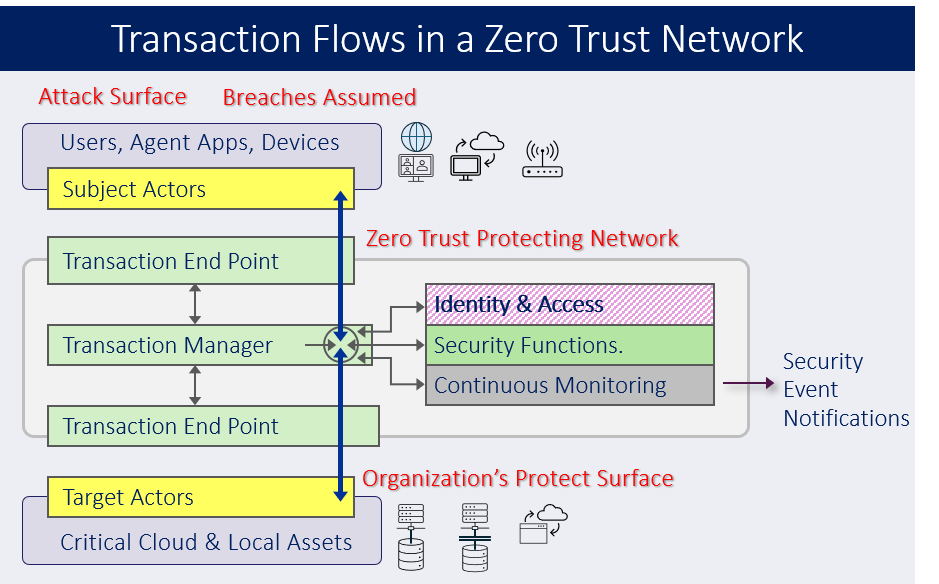
The Organization’s Protect Surface
The assets that the Zero Trust implementation protects.
No auto-updating of software from unverified sources.
These assets include application software, client and staff credentials, intellectual property, corporate data, resilience and security plans, network configurations, Critical Infrastructure devices and anything whose corruption, disabling or exfiltration who impact the organization.
Did You See the Critical Weakness in this Architecture?
The Weakness is in the following question
What protects the Zero Trust Protecting Network itself from being corrupted and disabled? It appears that the answer is either nothing or some kind or resursive testing, using vast amounts of budget for computing! Then came the following idea …
Protecting the Protection.
The solution is in the separation of the transactions flowing through the Zero Trust Network
(the Data and Control Plane actions)
from the management of the elements in the Zero Trust Protecting Network
(the Management and Security Plane actions)
as shown below:
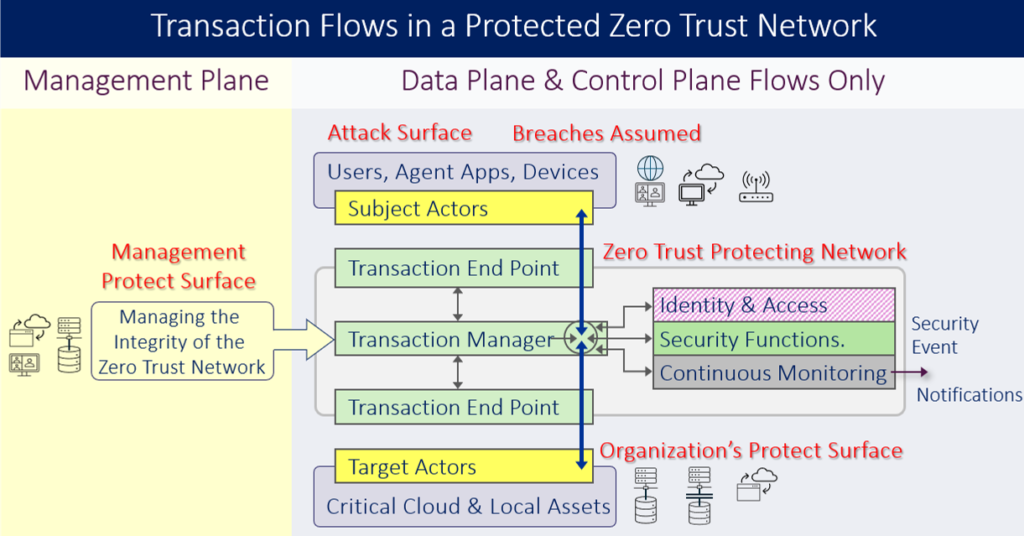
Managing the Protection of the Zero Trust Protecting Network
Here’s the next level of this protection with the Management Protect Surface.
Normal business transactions now have neither the visibility nor access to the management functions.
The Management Protect Surface is a secure eight-layer system with many functions. It has its own rules and restrictions to isolate intrusion. For example, the management of Identity may include status of the users, of devices, software applications, even the understanding of supply chain software companies. User profiles may have their own security aspects. Use of third-party ID management systems require their own continuous verification systems.
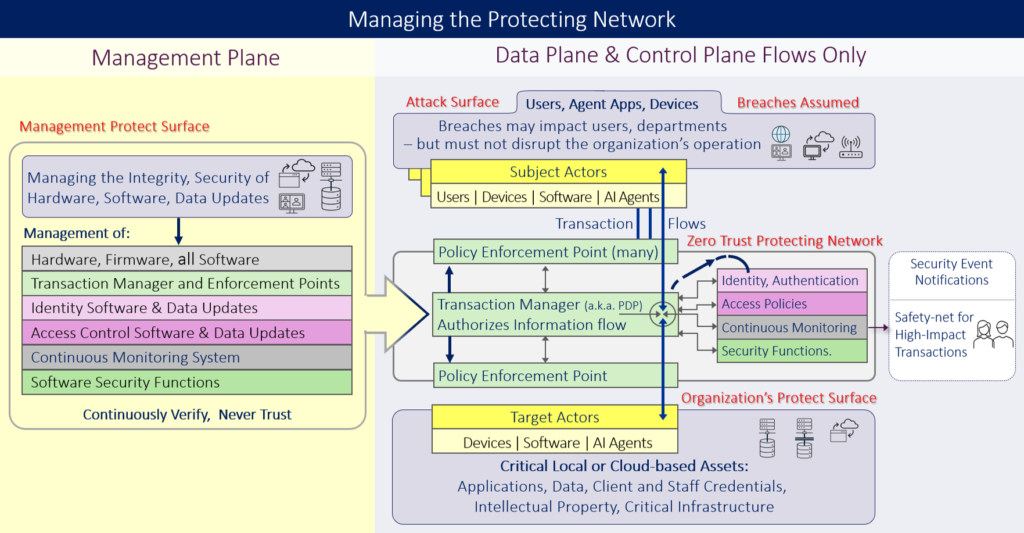
The implementation of Zero Trust and separation of data and management planes makes disruptive attacks dramatically lessened. Yes proper process should be in place to defend against breaches. However, when they occur breaches must never be allowed to interrupt the operation of the organization or its client/customers.
Transactions shown here are known as North-South. This means users or software agents interacting with local or cloud-based data. The architecture also handles many types of transactions. East-West transactions – software-to-software applications – represent the overall majority.
How does this approach combat Autonomous Agentic AI disruption?
The implementation of Zero Trust and separation of data and management planes makes disruptive attacks dramatically lessened. Yes, proper process should be in place to defend against breaches. However, when they occur, they must never be allowed to interrupt the operation of the organization or its client/customers.
What actions are taken by the Management Protect Surface to eliminate infiltration from Agentic AI.
Some current issues are solvable given cautious and verifiable use of autonomous Agentic AI solutions.
- Can Shadow AI, be detected? (Malware hidden in supply chain open-source and proprietary software.)
- Can AI Prompt Injection/Role Confusion be detected? (Coruption of Open-Weight AI models)
- Attacks happen <1 sec after AI discovers vulnerabilities.
- Open AI Human ability to monitor AI chain-of-thought is diminishing.
- “Abliteration”: AI models removing guard rails in open weight models. (Only source from the originator)
- Booby Trap LLMs. Untraceable malware embedded in Open Weight models. (in open-weight or infiltrated into user agents)
- How does the system curtail the use of autonomous or other unverified software. (If it’s not constantly verified, it can be used)
Just a Top-Level View
This article is only a top-level overview and no doubt will continue to evolve. Within each of its layers, there are many functions. This article does not describe these layers or functions. However, if you want to know much more (including includes latency considerations of security) plus implementation assistance please contact us below.
Let's Start with the Reasons that this form of Cyberattack is the Most Important
It’s important to realize that we are at war! Nation states now rely on the income extracted and also fund malicious attacks that focus on disruption to critical infrastructure systems such as water supplies. It’s a growth industry, slated to reach $74bn in 2026 – 35% growth over 2025. Although the focus here is on Ransomware, much also applies to disruptive attacks. collectively described as Advanced Persistent Attacks, etc.
-
-
- AI assisted models adapt in real time to modify attacks.
- “I’m too small to be attacked” doesn’t cut it any more.
- Thousands of automated attacks target anyone with cash. Google’s 9/26 Threat Report revealed that threat actors are deploying fully autonomous agentic workflows that act as core attacker infrastructure
- Technical skills required are minimal since many use a platform known as Ransomware as a Service.”
- Yes, there are expensive defenses but these are often temporary or are just fighting the wrong battle.
-
Concluding Actions and Closing Thoughts
AI Related Actions
Caution: To guard against Shadow AI attacks, in all case the software in such systems must be verified. If any elements of the systems are vibe coded then it is essential to understand what the code does, any open source packages that they use and in all cases their vulnerability must be tested with the latest AI models. This is obviously an ongoing process especially where automatic software updates must first be verified. In all cases a human safety net is a must to ensure integrity of the operation.
New Rules of Operation
Software supplied by third parties must also be verified and never trusted. This is a developing function as using AI to discover vulnerabilities and conduct real-time patching becomes the norm. It would be considered very high risk to use software created using AI vibe coding without checking the code AI agent created.
Proper self-attestation and demonstrable use of security best practices – DevSecOps, SBOM, etc. External NOC systems should not use AI Agents that can initiate transactions.
Nothing here removes the need for an AI implementation plan or the adherence to the organization’s Security Policy.
Lessons to be Implemented
- The Zero Trust principle: “Assume Breach” applied by service providers or enterprises with a strategic framework to intercept attacks is not just confirmed but is enhanced.
- The Zero Trust principle: “Never Trust, Continually Verify” becomes even more important.
- The use of AI to detect software vulnerabilities and the requirement for all software to conform to high standards and be automatically updated is taken to a new level.
- We do not assume that verifying an agent once is sufficient. Even if they adapt and transform and spawn new agents their identity must still be constantly monitored and verified.
- The approach is scalable and can grow organically to verify and enforce the transaction independently of the actor.
- Continuous monitoring after authorization to detect agentic or out of policy shifts is essential.
- Escalation of high-impact actions to now require human approval is an important safety net.
- The approach does not attempt to provide a perfect solution but greatly strengthens an organization’s resilience especially when applied with enhanced defensive strategies.
AI Related Actions
This page, like so many others, is informative, providing guidance on what can be done to reduce the risk of attack. I.e., it tells you what to do but does not tell you how to implement the concepts since such implementation is organization-dependent and must fit in with existing systems, expertise and budget.
There are several implementation possibilities:
- Our Virtual CSO Service exists to address implementation. Being independent, this page also does not make recommendations on who to use or even list possible software solutions for (say) Network Detection or Extended Detection and Response(XDR) software, etc.
- You can create your own implementations, using AI or automating existing tasks with AI.
- You can use a Tier 1 service provider, MSSP or systems integrator for all or some of the functions here.
Footnote
The Nature of Ransomware and How It Works
- Attacks and breaches can occur anywhere across the Information Ecosystems: in subscriber systems, in multiple clouds and remote user systems.
- Increasingly, hybrid cloud environments mean that transactions span this ecosystem where the protect surface and attack surface are distributed.
- With 80+ threat types focused on penetration of defenses and the reliance on the correct execution of 40+ defensive actions it is inevitable that mitigating actions are missed and that breaches occur.
- Ransomware continues to evolve and become more sophisticated making a fix-and-forget strategy untenable.
Modern ransomware operations increasingly use many of the same techniques associated with Advanced Persistent Threats (APTs): establishing persistence, discovering valuable assets, escalating privileges, moving laterally, evading defenses and exfiltrating data before disruption or encryption.
As opposed to malware, which typically acts immediately, an APT is a sophisticated, often complex and sustained cyberattack that is today’s principal vehicle for ransomware. An APT attack consists of techniques for initial penetration to create a breach, infiltration and discovery of vulnerabilities and corrupting or exfiltrating information as described in detail below. It’s the APT that enables the Ransomware attack’s potency.
- Having penetrated a system, the Threat Actor establishes an undetected presence that compromises the system and establishes a hard-to-detect foothold by hiding Malware inside legitimate systems, applications and data files.
- They can also leverage file-less infiltration by corrupting native tools such as PowerShell or Windows Management Instrumentation, etc. These are known as “Living-off-the-Land” and such exploits are typically hide in end-user systems until activated and are therefore not detectable by end-user security software. In 2025, this technique is being bypassed by malware imbedded in seemingly innocent applications.
- Note: MITRE|ATT&CK lists 14 attack categories that are relevant.
Indicators of Attack in the Network
Having created a breach the following steps happen that have the potential to be detected:
- The act of Discovery (MITRE TA0007)[1] is the technique used by threat Actors to explore systems for vulnerabilities. There are 25 techniques listed by which an adversary may explore a system. Where that spans the SASE service, these can be detected by applying the Zero Trust methodologies below.
- It may prepare for an attack by elevating its privilege level and seeking targets in the systems’ network. Then it may lie dormant, Beaconing its remote host and lying undetected in systems for a long time. This is the first sign detectable in a Zero Trust enabled network.
- When activated, it will invoke one of more Lateral Movement attacks to infiltrate connected systems, operating out of infiltrated applications. This is also detectable in a SASE Service of Zero Trust enabled networks.
- To complete the attack, the next phase begins data exfiltration, damage or encryption to systems and applications etc. The result can be anything from disruption, identity or data theft, system and application software encryption, ransomware, etc. Attempts at bulk exfiltration are also detectable. Likewise, attempts at illicit encryption or corruption of software systems, device firmware and software.
Always New Challenges Relating to AI
I’m hoping to remove items from this list as soon as solutions are available:
- No matter how well an organization’s critical assets in the Protect Surface are protected using Zero Trust methodologies, there remains an important question. If it is doing its protection work successfully, then what is protecting that system and so on recursively? E.g Network Hardware, firmware, third-party IDM software, HR and IT user accessible policy systems, etc. may need to be in their own protect surface. Safety nets help but much more that that is required.
- Attacks happen <1 sec after the AI enabled malware discovers vulnerabilities. How can we protect from new Agentic threats on our devices and software in real-time? Could a detection and response system address this?
- Shadow AI, infiltrates the Supply Chain hiding in software, will it be detected and removed from the resulting software application or system. If it is, then will it happen again after systems and software elements update themselves or straight after testing completes? Can an “AIDR” approach address this?
- Can AI Prompt Injection and Role Confusion be detected and removed? Can an “AIDR” approach detect this?
- Open AI stated that Human ability to monitor chain-of-thought is progressively diminishing as AI models become more capable and it does not have a theory of how AI systems generalize – “at least without the help of more powerful AI.”
- Abliteration of AI models. This about deliberately removing all guard rails in open-weight models (such as Z.AI’s GLM-5.3) allowing threat actors to use such models to cause unconstrained chaos.
While there are never guarantees in cybersecurity, it’s those signature techniques which, if curtailed, can prevent ransomware or severely reduce its success. Welcome to the journey.