
THE JOURNEY TO THE AI EVOLUTION
(A living Cybyr.com Document)
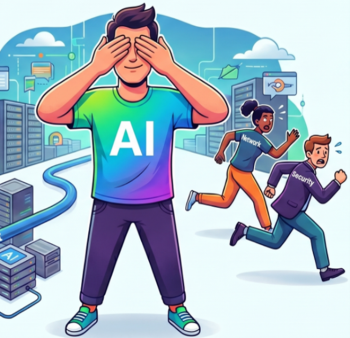
AI is Coming, Ready or Not
This page is a living page that will develop the story of the AI evolution.
Orginally published in the summer 2026 edition of ISE Magazine.

Intention
We are in the midst of the most exciting technology evolution, greater than when the Internet changed our lives almost five decades ago. My mid-2026 excitement comes from seeing it as a journey to a world where humans and AI collaborate developing outcomes that neither can create separately.
The Journey
This page looks out of the window of the AI train as new ideas and landscapes come into view and speed by. It begins with the AI Networking Summit in May of this year (onug.net). It continues with developments of topics raised in the event and their progress during the year. It describes areas that the conference did not cover but are no less important. Together, it encompasses AI, networking and security in 2026 and beyond.
May 2026
The Open Network User Group’s collaborative AI Networking Summit in May of this year (onug.net). This event brought together Enterprises and their providers as they explored their current state-of-AI-Networking-implementation and its challenges. Speaking with Nick Lippis, ONUG co-founder and co-chair, we agreed that the following are the main points arising from the conference that must be addressed.
AI is Coming, Ready or Not
Almost everyone agrees: no matter how ready developers are, AI is coming very quickly, whether we are ready or not. The long-term future of IT and networking in general will be highly uncertain, perhaps for the next two years. Experimentation will remain the order of the day during that time.
- As one of many findings of IDC’s survey, security concerns are rated number one and are part of every AI conversation.
- Slow governance and compliance adoption are inhibitors to scaling AI.
- The issue of guardrails and preventative measures is very dynamic, with instances of threat actors using AI to exploit AI’s automation capabilities. This is creating new threats at lightning speed without the need for technical expertise.
- The necessary migration to AI-architected networking has a way to go and will need to accommodate cloud or hybrid implementation over the next two years.
- The decision to build, buy or develop hybrid solutions is governed by cost, functionality and security. Even here, there is a split between platform and best-of-breed solutions.
- My observation: only the largest organizations have developed AI implementation policies to accompany resilience and security policies. Clear implementation planning and policies are essential to prevent ongoing AI adoption from being abandoned.
The plan is to check in with progress on this page and at the ONUG Fall Summit. Other topics are, of course, cost, agentic sprawl, Network Operating Centers and much more.
June 2026
Can Next Generation Ai Crush Ransomware?
Anthropic’s Glasswing project found 10,000+ high-severity vulnerabilities across widely used software projects.
There are thoughts that the next generation of AI could curtail cyber-attacks on software by 70-90% over time. It may help indirectly with all other attacks (phishing, social engineering, misconfiguration and supply chain issues that involve software) and change the game against ransomware-as-a-service threats.
Bad News on the Doorstep
To mess with Don Maclean’s famous song, some want it to be the day that AI died or bye-bye Miss American AI. But the Luddites didn’t win the first industrial revolution, and I don’t think they will win this evolution.
However, there is no doubt that political and state-sponsored disruption is real and aimed at slowing progress. The reality is that the current data center build-out is not dealing with power and water shortfalls with a sense of urgency. In fact, the AI community appears to be ignoring these fears, not making friends or public statements that AI will lower power consumption as devices become efficient, that water recycling is beginning, as is new job creation—nor that all parties are considering partial public ownership of what are becoming monster AI companies.
AI-Driven Organizations
ExO’s Salim Ismail’s new work on exponential organizations says, “Don’t try to fit AI into the organization—it doesn’t work! Instead, reimagine the organization with AI at its center.”
I would add: Start by appointing a Chief AI Officer and replacing antiquated structures. Job two would be the creation of a Secure AI Implementation Policy to remove the current chaos present in 90% of organizations, as we mentioned earlier.
June-July 2026
Can Next Generation Ai Crush Ransomware?
- The demise and resurrection of Anthropic’s Glasswing project was a testament to how to create a fiasco and save the faces of those involved. Having made the ridiculous decision to place Mythos/Fable 5 on the supply-chain banned list. Only for the eventual re-release of Fable 5 for the general population and Mythos 5 for enterprises. However, the re-released Fable 5 has degraded performance, having “nerfed” performance. On Reddit, users reported that it’s weaker, being routed through stricter safety systems.
- Also, since the AI Summit, the United States government has taken a proactive role in evaluating the AI cybersecurity integrity of AI models in a voluntary initiative. Also, the White House announced it is creating a formal AI–Cybersecurity Coordination Group to shift from regulating AI to using AI as part of national cyber defense.
Agentic AI Identity and Authorization: Will AI Break Zero Trust?
“How do we authenticate AI agents?” is more importantly stated as “How do we preserve Zero Trust when the actor is no longer a human, static software or a device?”
This is critical because AI agents initiating transactions must have their identity and policy conformance approved. If not, then Zero Trust will be broken. Transient AI agents need to dynamically comply with access policies as they do for IoTs, etc. This is a very high priority until the end of 2026.
My initiative on using proxy or supervisory software to continually verify identity and policies so as to authorize all transactions is getting some traction. This becomes a crucial guardrail present for all interactions. Dynamically generated Agentic AI actors can similarly be policed with dynamic policy enforcement. Although written before the dynamic proliferation of Agentic AI began, the Cloud Security Alliance wrote a forward-looking paper on the issue, recognizing its importance. This initiative will continue.
July 2026
Harmonizing Human and AI Strengths.
A New Collaboration That Creates Results That Neither Can Create Separately
Other AI Developments
- AI-powered cybercrime keeps accelerating.
- AI is now shrinking the “patch window.”
- AI agents are becoming a new attack surface.
- The AI race is shifting from “Who builds the smartest model?” to “Who can deploy AI safely, securely and at national scale?”
- July saw some cracks in the development of the AI market following the huge growth in the past year.
This topic is a continuation of my previous ISE article on Harmonizing Nine Human Strengths with AI, achieving collectively what cannot be achieved separately.
The main point is to eliminate many user fears that AI will take us over. After it was published, I realized that I missed a strength more important than all others: Leadership.
Humans can bring leadership qualities to inspire, empower and set transformative purpose for individuals, organizations and communities. Yes, AI does a good job of expanding these ideas, but it’s really not in the leadership business. I bring all this together in my Expert-Guided AI software.
Finally, I have begun to have an surprising relationship with AI. I give provide a new strategy to AI that it expands and surprisingly expands and enhances. As the subheading states, this collaboration results in conclusions and strategies that would not be possible to either separately.
August 2026
June 2026
Dilemas, Twists and Conformance.
Guard Rails, Testing and New Approaches
Topic of the month are definitely the growth of the capabilities of AI to stregthen the scurity of systems while containing the risks. The escape into the wild of both Open AI and An thropic AI models under test stopped people and govenments in their tracks. The US government is all over this as covered in Breaking News #49-53 and on our Hot Topics page.
We will follow the progress of ExploitGYM, GRAM stories here as they develop.
September 2026
Marketing Disguised as Politics and Business Strategy
When elections approach anything goes. Politicians with no interest in the understanding of a topic will use fearmongering and fake information to get votes. It’s called marketing.
When flagship AI companies raise “end of he world fears” it’s no sci-fi scenario. It’s simply to have regulators slow down competitors while they go faster. It’s called marketing.
It is also a convenient cover up beaches by all the frontier models during product testing because they used incompetent testing, or worse test companies that poisition themselves as compitent, or even worse, their products are not built using DevSecOps which includes using unverified supply chain code.
(End of rant that comes from 25 years in marketng and a decade in a network testing company ).`
Panic in the Streets - or is it just marketing hype?
When elections approach anything goes. Politicians with no interest in the understanding of a topic will use fearmongering and fake information to get votes. It’s called marketing.
When flagship AI companies raise “end of he world fears” it’s no sci-fi scenario. It’s simply to have regulators slow down competitors while they go faster. It’s called marketing.
It is also a convenient cover up beaches by all the frontier models during product testing because they used incompetent testing, or worse test companies that poisition themselves as compitent, or even worse, their products are not built using DevSecOps which includes using unverified supply chain code.
(End of rant that comes from 25 years in marketng and a decade in a network testing company ).`
September - October 2026
Three Difficult Security Issues
Most threats can de detected and resolved. There are still three issues that are to yet be resolved:
- Shadow AI buries malicious code inside supply chain software including ope-source elements. How can this be prevented or even verified when Threat actors can find and exploit vulnerabilities maybe even after testing is complete and/or products are installed?
- Is Prompt Injection/Role Confusion a big threat even if it can be detected?
- Even after systems are protected say with a protecting system protecting a Protection Surface, who protects the protection system from attack then recursively who protects the protectors?
Redefining AI Collaboration into a Strategic Model
This is a model for “Thinking With AI” not just Using AI to ask questions.
AI Collaboration is a methodology in which humans and AI models iteratively combine their different strengths.
- Humans contribute ideas, experience, context, judgment, creativity and objectives.
- AI draws upon its access to vast amounts of information and accumulated knowledge to evaluate those ideas, test assumptions, identify weaknesses and alternative perspectives, and propose enhancements or counter-proposals.
- The process continues iteratively, with both the human and the AI asking questions, challenging assumptions and redirecting the inquiry as new insights emerge. Human judgment and responsibility remain central.
The objective is not simply to obtain an answer from AI, but to develop a result that is superior to what either the human or the AI would likely have developed independently.
The methodology can extend beyond one human and one AI model to include multiple humans, AI models and agents collaborating together, including in open meetings and working sessions.
This is fundamentally different from the common use of AI for Q&A, search, information retrieval or task execution. The AI is not simply answering a question or completing an instruction; it is participating in an evolving process of exploration, challenge and refinement.
In summary: the human contributes depth of lived experience and judgment. AI contributes breadth of information and connections. Finally, do not be fooled into believing that AI diminishes cognitive thinking. It results in enhanced human cognitive ability to think more carefully and structurally about any topic or idea.